



Article Summary: Integrating AAC and Smart Home Devices
Published on Jul 17, 2020
Pairing an AAC device with a smart home assistant may do more than add convenience — it could change how motivated your clients are to use their device in everyday life. This summary covers the key insights from an ASHA Leader article, and explores how to put them into practice with a Lingraphica device.
About this article summary
This summary of “’Alexa, Call My SLP’: Using Smart Tech to Boost AAC” (Williamson, 2019) was written by Dr. Richard Steele, a senior researcher at Lingraphica who retired in 2024. It reflects his interpretation of an article published in the ASHA Leader and is intended for educational purposes.
Research findings and clinical best practices may change over time. These summaries are generally maintained as part of our educational archive and are not routinely updated. We encourage readers to review the original article and consult current evidence when applying findings in clinical practice.
Speech-language pathologists with clinical or patient questions about AAC are invited to consult with our SLP Clinical Education team.
Key Takeaways
- Pairing AAC with a smart home speaker can improve motivation to use a device.
- The AAC + smart home speaker combination increases user independence with environmental controls and can improve social engagement.
- Start small with a dedicated page of meaningful phrases to use with a smart home assistant.
Exploring Williamson’s suggestions inside the article
Smart home assistants, such as Amazon Echo and Google Home, are becoming common parts of many households. This presents a unique opportunity for AAC users to use these voice-operated systems by programming commands into their device.
By combining the powers of AAC with smart home assistants, AAC users are likely to experience benefits in four areas:
- Motivation and entertainment: For many, the idea of using AAC with a smart home assistant is simply rewarding and fun. It is motivating for users to be able to use the newest technology via their devices. Furthermore, there are many fun commands that can be programmed, including telling jokes or checking sports scores.
- Social and community engagement: With the help of a smart home assistant, AAC users will find it easier to make phone and video calls to stay connected. They can also stay engaged with the community by checking the news, and use the system’s schedule feature to get their day started.
- Environmental controls: If the user has the right tools, a smart home assistant can control everything from the lights to the TV to the thermostat. This can greatly increase an AAC device user’s independence.
- Medical/emergency support: Pairing AAC with a smart home assistant can be a large benefit. An easy emergency or panic button can be created by instructing the smart home assistant to call for emergency services.
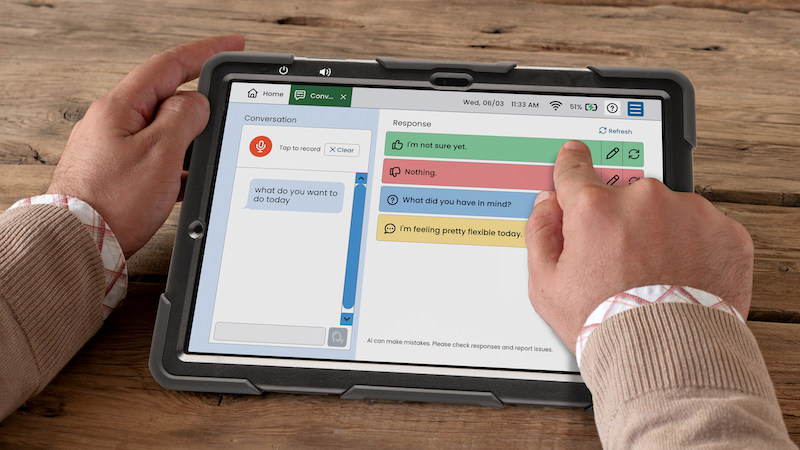
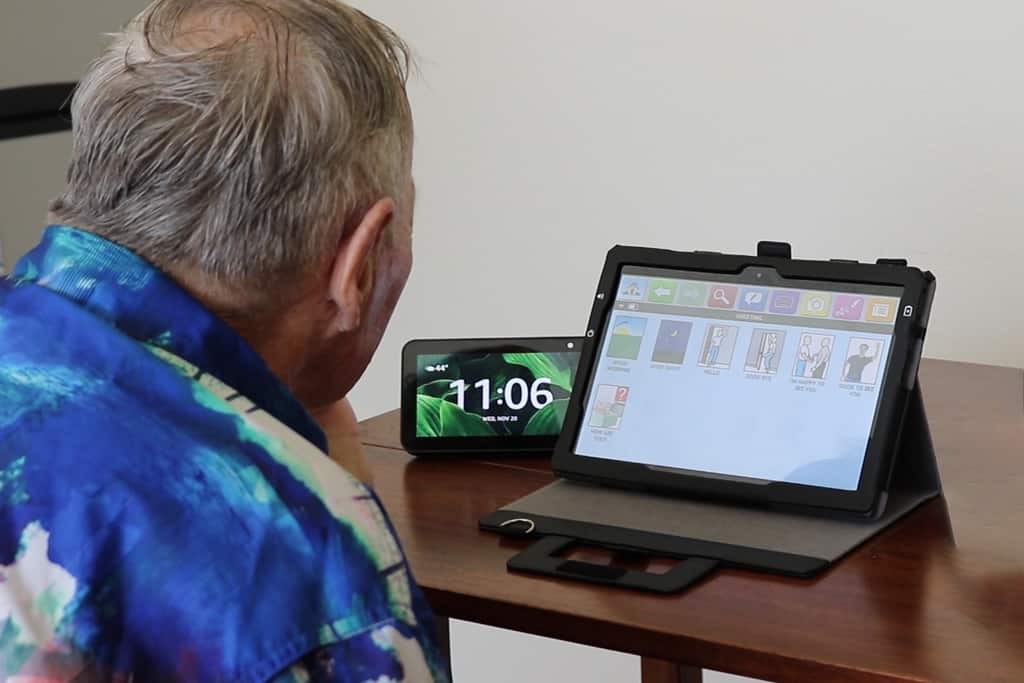
Although it can feel intimidating to combine the technology, it’s easy to start small. Identify a couple of meaningful voice commands and create a dedicated page on the AAC device to make the connection easy.
Incorporating Smart Home Technology into AAC Practice with Lingraphica
Lingraphica AAC devices are ready to communicate with a smart home assistant right away. They come pre-programmed with folders for Alexa, Google Home, and more. Each includes some of the most common voice commands. You can find this vocabulary in the Card Library under “Technology.”
When using a Lingraphica AAC device with a patient, ask if they use a smart home assistant. If yes, identify some of the things that are important to them – not only will this help you customize the device, but you can also think of ways to incorporate the smart home speaker to increase motivation and independence. This could be something simple, like hearing the day’s weather report or checking a favorite team’s score.
If your patient seems hesitant to use a device to communicate with others, using a device to communicate with a smart home assistant can be a great way to “break the ice.” Using the device to interact with a smart home speaker removes some of the pressure and any embarrassment your patient might feel at using a device with friends and family. Communicating with a smart home assistant can help build the skills, confidence, and comfort that the user needs to begin communicating in other contexts.
References
Williamson, F. (2019, May). ‘Alexa, call my SLP’: Using smart tech to boost AAC. The ASHA Leader, 24(5), 44–51. https://doi.org/10.1044/leader.FTR1.24052019.44
About Contributor
 Lingraphica Team
AAC Experts
Lingraphica Team
AAC Experts
Lingraphica helps people with speech and language impairments improve their communication, speech, and quality of life. Try a Lingraphica AAC device for free.
Contributors
Lingraphica Team
AAC Experts
Categories
Subscribe to newsletter
Share