




Article Summary: Treating primary progressive aphasia with AAC
Published on Jul 17, 2020
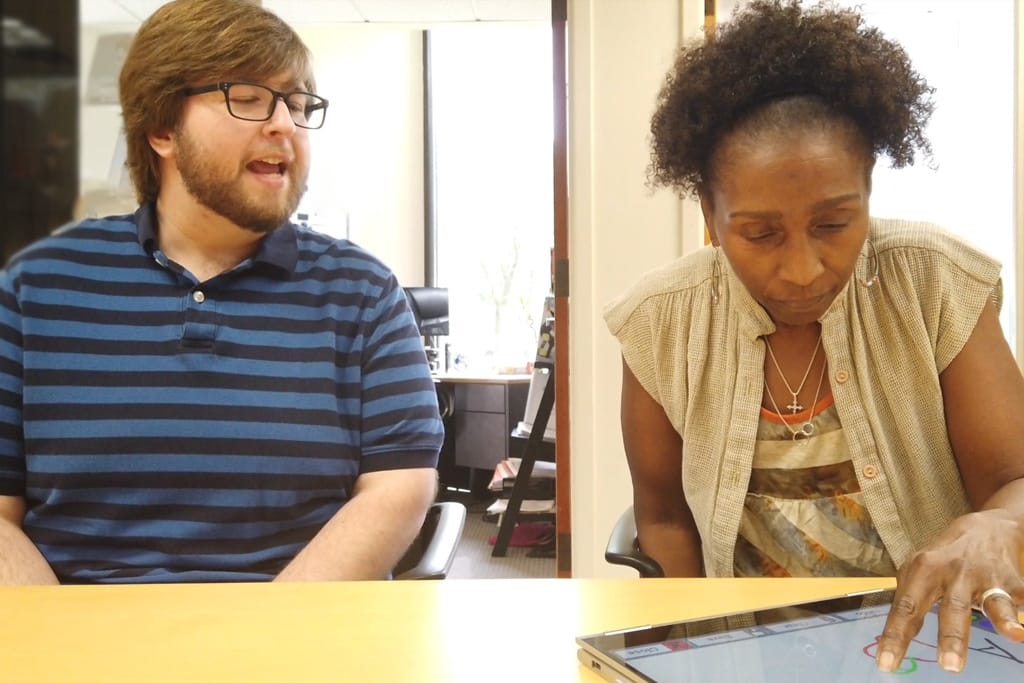
Treating primary progressive aphasia with AAC looks very different from other types of aphasia. Fried-Oken’s five-stage treatment structure might be the key to effective PPA treatment — and this approach starts earlier than most SLPs realize. This summary breaks down the five-stage treatment framework, what it means for device setup and communication partner involvement, and how to apply it with a Lingraphica device in clinical practice.
About this article summary
This summary of “Augmentative and Alternative Communication Treatment for Persons With Primary Progressive Aphasia” (Fried-Oken, 2008) was written by Dr. Richard Steele, a senior researcher at Lingraphica who retired in 2024. It reflects his interpretation of this published article and is intended for educational purposes.
Research findings and clinical best practices may change over time. These summaries are generally maintained as part of our educational archive and are not routinely updated. We encourage readers to review the original publication and consult current evidence when applying findings in clinical practice.
Speech-language pathologists with clinical or patient questions about AAC are invited to consult with our SLP Clinical Education team.
Key Takeaways
- There are three key goals when using AAC with someone with primary progressive aphasia (PPA):
- Compensate for language loss
- Start AAC use early in the disease progression
- Involve communication partners
- Multimodal communication options that include pictures are best practice as language skills decline.
Exploring Fried-Oken’s suggestions inside the article
Primary progressive aphasia (PPA) is a degenerative language disorder that does not easily fit into the classical aphasia typology (Duffy & Petersen, 1992). Because of this, guidance is often needed about when and how to introduce AAC.
The author outlines two primary treatment challenges when using AAC with a person with PPA:
- How to provide a visual vocabulary to enable the person to participate in daily life activities as language declines
- How to modify the environment to support communication
Based on these considerations, there are generally three goals to address when starting to use AAC with a person with PPA.
First, to try to compensate for language loss as skills deteriorate. This is in contrast to someone with another type of aphasia, where the goal is likely to improve language skills.
Second, to identify a device candidate and introduce AAC as soon as possible. This allows the person to learn the tools that are available before needing to largely rely on them.
Lastly, to involve communication partners in AAC device training, as they will become increasingly important as the person with PPA’s language skills decline. Remember: your patient does not need to be independent with AAC to be considered a successful device user.
The author proposes a five-stage treatment framework for individuals with PPA. This is based on the degree of language impairment. As the levels progress, the patient is likely to rely more heavily on AAC, and communication partner support becomes crucial.
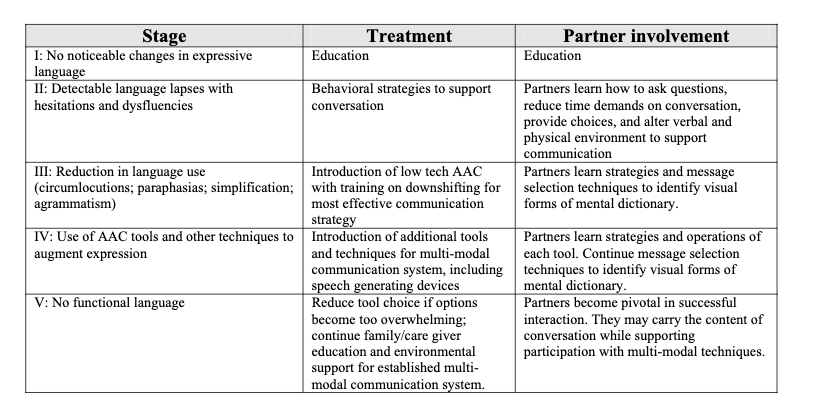
From “Augmentative and alternative communication treatment for persons with primary progressive aphasia,” by M. Fried-Oken, 2008, Perspectives on Augmentative and Alternative Communication, 17(3), p. 101. https://doi.org/10.1044/aac17.3.99
It is also noted that in the final stage of progression, the AAC tool may need to be simplified to meet the user’s changing needs. Any system chosen should rely heavily on images, as someone with PPA will largely use their visual skills in later stages of progression.
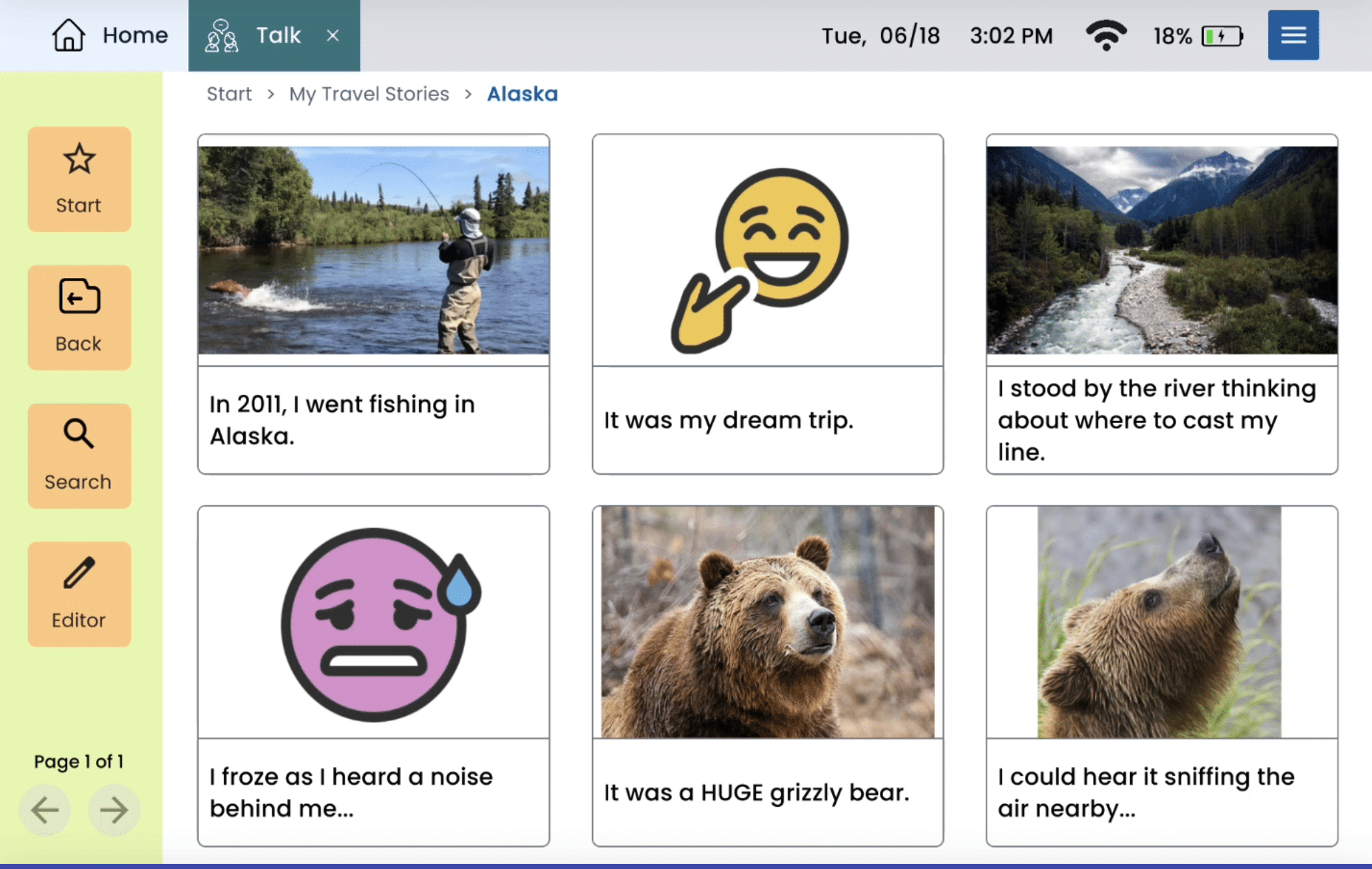
When using a high-tech device, it’s critical to address the patient’s communication goals and use tools to determine what is most functional and meaningful for the user. Using the device to store and share autobiographical memories can be very rewarding for many.
Incorporating PPA recommendations into clinical practice with Lingraphica
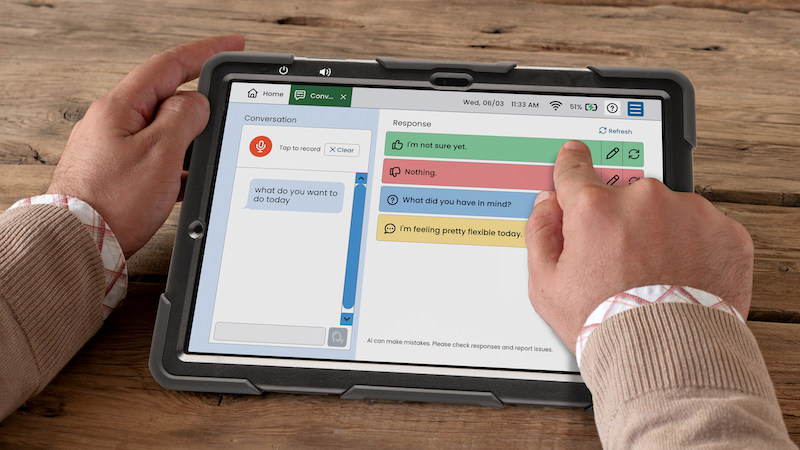
Lingraphica AAC devices are designed to support multimodal communication. They can be fully customized to include personally relevant photos and drawings. These are both great starting points for someone with PPA.
When using an AAC device with someone with PPA, it’s critical to create a device that will meet their needs immediately, while also being easy to modify as language skills decline.
One recommendation when programming a device for a person with PPA is to make sure the most important and meaningful vocabulary is at the top of the page, and within 1-2 layers of the home page. Additional vocabulary can be stored farther down the page or deeper within the system. By doing this, it is easy to simplify the device if needed as the impairment becomes more severe, without needing to change the organization that the user has already learned.
Another best practice when working with someone with PPA is using the voice recording feature. If you start early with AAC, the user has the opportunity to record messages in their own voice while they still have intact speech and language skills. This can be especially meaningful for family members’ names, phrases like “I love you,” and any personal “catchphrases.”
As stated in the article, two key components are to start early and involve communication partners as much as possible. This enables both the user and the communication partner to learn the AAC system while communication skills are still at a higher level. As the impairment progresses, the communication partner should be prepared to provide additional assistance supporting the use of the device.
References
Duffy, J. R., & Petersen, R. C. (1992). Primary progressive aphasia. Aphasiology, 6(1), 1–15. https://doi.org/10.1080/02687039208248573
Fried-Oken, M. (2008). Augmentative and alternative communication treatment for persons with primary progressive aphasia. Perspectives on Augmentative and Alternative Communication, 17(3), 99–104. https://doi.org/10.1044/aac17.3.99
About Contributor
 Lingraphica Team
AAC Experts
Lingraphica Team
AAC Experts
Lingraphica helps people with speech and language impairments improve their communication, speech, and quality of life. Try a Lingraphica AAC device for free.
Contributors
Lingraphica Team
AAC Experts
Categories
Subscribe to newsletter
Share