





How to introduce an AAC device: a guide for SLPs
Published on Jul 02, 2026
- How to start AAC introduction with confidence
- 1. Start with the right candidate
- 2. Let go of prerequisites
- 3. Approach AAC introduction as communication, not an evaluation
- 4. Keep the setup simple
- 5. Break the ice with something familiar
- 6. Stay in communication mode
- 7. Motivate through early wins
- 8. Address common challenges without overcomplicating them
- Top three takeaways:
Introducing high-tech AAC can feel daunting — but it doesn’t have to. This guide gives SLPs practical strategies to start sessions with confidence, keep communication patient-centered, and build engagement from the very first interaction.
How to start AAC introduction with confidence
Are you new to high-tech AAC?
First of all, welcome! You’re about to give so many people the most powerful tool in the world: a voice.
Starting AAC with a new patient can feel uncertain, even for experienced clinicians.
It’s common to hear that little voice in your head tap your frontal lobe and ask questions like:
What if they don’t respond? What if I do this wrong? What if the session feels awkward?
Those feelings are normal and usually mean you care about getting it right.
This article offers practical guidance to SLPs for AAC implementation.
Keep reading to learn how to approach device introduction in a way that feels natural, patient-centered, and clinically grounded, without a rigid script.
1. Start with the right candidate
Before the first session, confirm that the patient is a good fit for a high-tech AAC device.
A clear candidacy evaluation helps you enter the introduction with realistic goals and a stronger sense of direction. If you’re still working through that step, we’ve got your back!
Lingraphica’s guide on identifying device candidates is a helpful place to start.
2. Let go of prerequisites
In my early years as an SLP, I thought that we needed to wait for a patient to demonstrate certain skills before introducing a device.
First, they needed to show me:
- consistent yes/no responses
- a certain level of comprehension
- reliable motor control
That’s still a common barrier we see today.
Turns out, we need to take a hint from Princess Elsa and let it go!
AAC doesn’t require prerequisites — patients don’t need to “earn” access to communication.
The device is a tool for exploring what a patient can do. Letting go of that threshold mentality opens the door to earlier, more meaningful intervention.
3. Approach AAC introduction as communication, not an evaluation
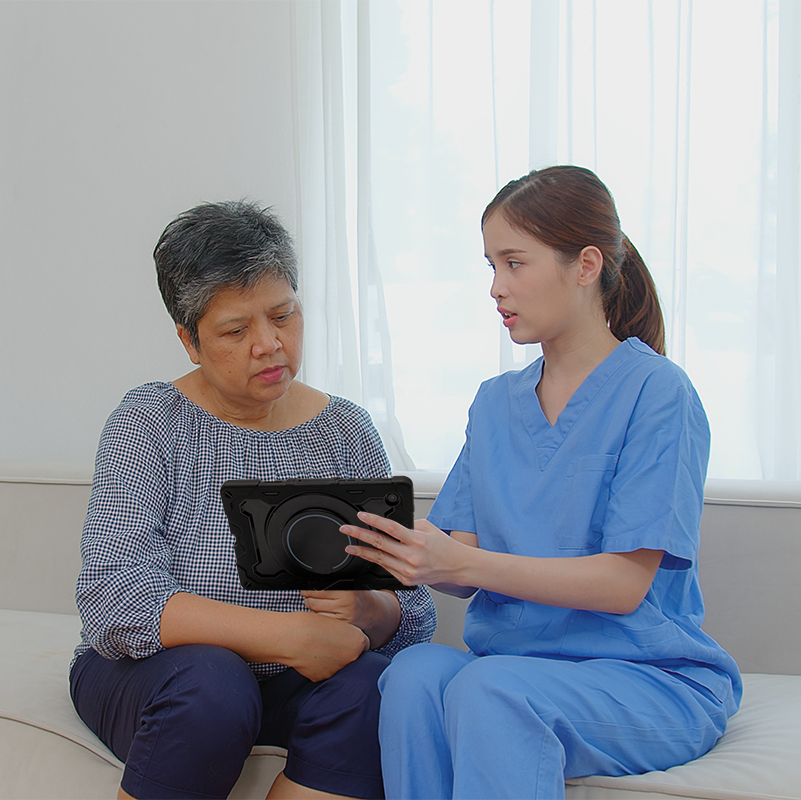
The first session with a device should feel like a conversation, not a test.
When SLPs enter the room focused on what the patient does with the device, it can subtly shift the dynamic. It can put pressure on performance rather than creating space for connection.
Instead, frame it like this: you’re here to talk with your patient, and the device is part of how that happens today.
This means resisting the urge to prompt for correct responses, rush through vocabulary, or treat the session as a skills assessment.
Follow the patient’s lead. If they gravitate toward a particular category or button, lean into that.
4. Keep the setup simple
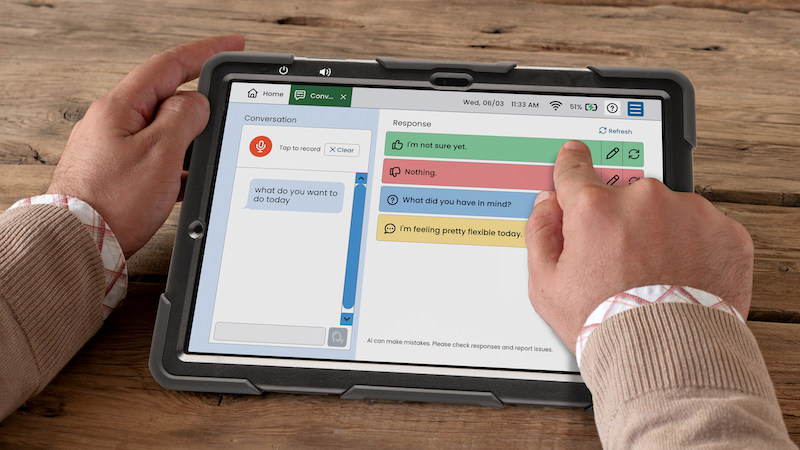
Instead of presenting your patient with a complex grid of options, consider starting with a small set of high-relevance vocabulary.
For example, use words and phrases connected to what actually matters in that patient’s life.
Their family members, favorite activities, needs they express frequently, things they want to say.
Personalizing the device before the session signals to the patient that this tool was made with them in mind (and who doesn’t love that?).
During the session, fewer options might lead to greater engagement and less overwhelm for your patient. You can (and should!) expand vocabulary as the patient becomes more comfortable navigating the device.
5. Break the ice with something familiar
A simple way to ease into a first session is to start with something the patient already knows how to talk about.
Ask about a family member by name, reference a hobby, or bring up something from their intake history.
When a patient sees their own life reflected in the device – like a photo of their dog or a phrase they use often – it shifts the device from “an intimidating piece of technology” to “a tool that understands me and helps me speak my mind.”
👆That shift in perception matters more than any therapy drill.
6. Stay in communication mode
During AAC sessions, it’s easy to slip into “teaching mode.”
Suddenly, we’re explaining how buttons work, modeling step-by-step navigation, and waiting for the patient to complete a structured task. But for many patients, this approach can feel distancing.
Staying in communication mode means responding to what the patient selects as if it’s part of a real conversation, because it is.
If they navigate to “water,” acknowledge it. If they pull up a phrase that doesn’t quite fit the moment, follow the thread anyway and see where it goes.
AAC therapy strategies that prioritize natural communication over structured performance tend to yield better engagement, especially with adult patients who may feel self-conscious about learning a new system.
7. Motivate through early wins
Patients who feel successful with a device are more likely to engage with it. Look for moments to reflect that success back to them!
When a patient navigates to something meaningful and you respond to it genuinely, that’s a win.
When a caregiver lights up because they understood something the patient expressed, that’s a win.
Small, real exchanges build motivation more reliably than structured tasks do, because they can see that the device is working.
8. Address common challenges without overcomplicating them
When a patient seems disengaged: Try shifting topics, changing the physical setup, or simply narrating what you’re doing with the device yourself. Sometimes modeling without expectation is enough to spark curiosity.
When the session feels slow or awkward: That’s OK. Silence and slow pacing are often part of how patients with communication disorders process and respond. Resist filling every pause.
When you’re uncertain in the moment: You don’t have to know every answer. If a patient navigates to something you don’t know how to program, note it and follow up. What matters more than technical mastery is that the patient feels heard and that communication is the shared goal.
Top three takeaways:
Communication over correctness. The goal of every session is connection and expression, not accurate button selection. Celebrate all communication attempts.
Progress over performance. AAC implementation takes time. Some patients will show immediate engagement; others need multiple sessions before the device feels natural.
Motivation builds momentum. When patients feel successful with the device, and when families see it working, engagement grows naturally over time.
AAC introduction doesn’t have a perfect starting point — as nice as that might sound. What it does have is a first conversation.
Once a patient is comfortable with the device, you can begin incorporating it into more structured AAC therapy strategies, but that comes later.
Focus on introducing AAC first, and the rest will follow.
About Contributor
 Lauren Hermann, MS, CCC-SLP
Guest Contributor
Lauren Hermann, MS, CCC-SLP
Guest Contributor
Contributors
Lauren Hermann, MS, CCC-SLP
Guest Contributor
Categories
Subscribe to newsletter
Share