





Research Summary: Making AAC successful following a stroke
Published on Jul 17, 2020

Research suggests that AAC success for people with aphasia depends on far more than language ability alone — and some of the most important factors may be ones SLPs don’t typically consider. Factors like age, cognition, clinician beliefs, and social support all play a role. This summary breaks down what the evidence shows and how to apply it with a Lingraphica device in clinical practice.
About this research summary
This summary of “High-Technology Augmentative and Alternative Communication in Poststroke Aphasia: A Review of the Factors That Contribute to Successful Augmentative and Alternative Communication Use” (Taylor et al., 2019) was written by Dr. Richard Steele, a senior researcher at Lingraphica who retired in 2024. It reflects his interpretation of a published research study and is intended for educational purposes.
Research findings and clinical best practices may change over time. These summaries are generally maintained as part of our educational archive and are not routinely updated. We encourage readers to review the original research publication and consult current evidence when applying findings in clinical practice.
Speech-language pathologists with clinical or patient questions about AAC are invited to consult with our SLP Clinical Education team.
Key Takeaways
- A person with aphasia’s success when using an AAC device is influenced by many more factors than just level of language ability.
- These factors include: age, client insight, cognitive level, social supports, therapist beliefs, and service delivery model. Each must be taken into account when considering AAC.
- Despite the presence of “negative” factors, a patient can still be successful with AAC by using the appropriate techniques and management strategies.
Exploring the research
High-tech AAC is becoming an increasingly common tool used as a compensatory strategy for people with aphasia. However, research into what specifically enables success with AAC has historically been somewhat limited. The authors of this article reviewed the available literature in order to create a thorough list of factors to consider and address when using AAC in the aphasia population.
Several studies have documented that people with aphasia can be very successful using high-tech AAC, especially as systems have evolved and technology has improved.
However, challenges have also been documented, including the following:
- People with aphasia tend to take longer to learn AAC than individuals with other communication impairments
- People with aphasia do not appear to generalize as well to untrained items
The exact reasons for this and the factors that contribute to success are areas that need additional research.
Drawing on factors that drive AAC success in other populations, the authors identified three key areas likely to determine whether a person with aphasia succeeds with high-tech AAC.
Body Structure and Function Factors
- Language impairment: the severity of language impairment may make it more difficult to learn to use symbols; may require longer training period
- Cognition: impaired cognition may reduce executive functioning for knowing when to switch strategies; may impact generalization abilities
Personal factors
- Age: Older users may be less familiar with technology; younger users may have more difficulty accepting their disability and use of AAC
- Insight and Expectations: ability to monitor communication; disappointment level when communication breakdowns occur
Environmental factors
- Social supports: increased opportunities for AAC use and support
- Therapist perspectives and beliefs: the proficiency of the clinician using AAC; the persisting trend not to introduce AAC until later stages of aphasia
- Duration and intensity of SLP services: may require more intense services to facilitate success
While this list is not exhaustive, it is an excellent starting point when introducing AAC to a patient. Each of these factors can be considered as part of an AAC evaluation. The authors also suggest several management strategies to address various factors, and stress that therapist beliefs may need to be addressed. For instance, success with an AAC device does not always mean that the patient uses the device independently; partner-dependent use is a good outcome for many people with aphasia. Furthermore, early introduction of AAC is encouraged, rather than viewing AAC as a last resort.
Incorporating the Research into Clinical Practice with Lingraphica
When considering whether a patient is a good candidate for an AAC device, the focus is typically on the level of language impairment. However, this article outlines several additional factors to consider whenever using a device with someone with aphasia.
Some strategies that can be used to address the factors in each area include:
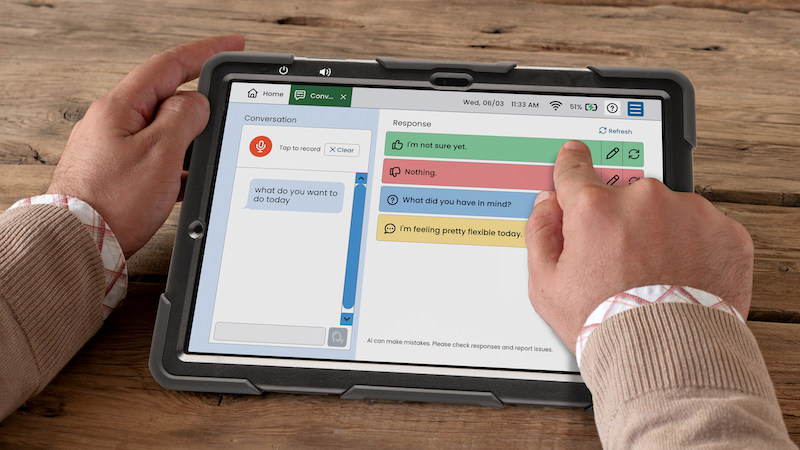
- Language and cognitive impairment: For patients with more severe impairments, start right away with simplifying the device. The goal is to ensure early success to build confidence and competence. At first, you can simplify the device’s home page or limit pictures and vocabulary to a smaller set of options. As your patient learns those, you can begin to add more as appropriate.
- Personal factors: Counseling your patient and their family on expectations when using the device is important to do early in the AAC process. Many patients and families hope and believe that a device will be a “magic wand” that makes communication easy again. Set up the realistic expectation that AAC is a powerful tool, but it also requires effort to learn, and communication breakdowns will still occur. Teaching patients and their families to recognize and celebrate successes is equally important.
- Environmental factors: Make sure to encourage communication partner involvement right away. Consider your service delivery model to ensure the patient is receiving an adequate intensity of speech therapy. This is also a time to lean on Lingraphica – our team of SLPs can work with patients and their families directly to provide additional support and training.
By taking these factors into account and considering the best ways to manage each of them – or at least being aware of their impact – potential barriers can often be addressed and corrected to increase the patient’s success.
References
Taylor, S., Wallace, S. J., & Wallace, S. E. (2019). High-technology augmentative and alternative communication in poststroke aphasia: A review of the factors that contribute to successful augmentative and alternative communication use. Perspectives of the ASHA Special Interest Groups, 4(3), 464–473. https://doi.org/10.1044/2019_PERS-SIG2-2018-0016
About Contributor
 Lingraphica Team
AAC Experts
Lingraphica Team
AAC Experts
Lingraphica helps people with speech and language impairments improve their communication, speech, and quality of life. Try a Lingraphica AAC device for free.
Contributors
Lingraphica Team
AAC Experts
Categories
Subscribe to newsletter
Share