





8 AAC tips to build confidence with a speech device
Published on Apr 10, 2026

- 1. Start AAC early
- 2. Make the device personal
- 3. Focus on real-life communication, not perfect sentences
- 4. Use AAC every day, even for small moments
- 5. Model the device naturally
- 6. It’s OK to need support
- 7. Keep it simple at first
- 8. Use the AAC support available to you
- Building confidence takes time (and that’s OK)
Like with most technology, starting with an alternative augmentative communication (AAC) device can feel overwhelming.
You might wonder, Will this ever feel natural? Will people have the patience to wait while I find the right words? Am I missing something?
Here’s the thing: Building confidence with AAC doesn’t happen overnight. But the beautiful thing is that with the right AAC tips and support, you or your loved one can speed up the process!
Whether you’re a device user, care partner, or SLP, let’s walk through eight practical AAC tips that can help you build that confidence.
1. Start AAC early
One of the biggest myths about AAC is that it should only be used after speech therapy “fails.” That’s like trying to reach the top shelf with a step stool when you need a ladder (and you know that box of Oreos is waiting for you…)
AAC devices give you a way to communicate right now – and they can be introduced alongside traditional therapy, not in spite of it.
When someone can communicate right away, even in simple ways, confidence grows. Instead of feeling stuck, they feel heard.
If you’re considering AAC or just starting out, don’t wait for the “perfect” time. The sooner you begin exploring communication options, the sooner you can start participating fully in conversations again.
2. Make the device personal
You know how your cell phone is tailored to you? The photos, the apps, maybe even the screen saver…
That’s how your speech device should feel. It should reflect your life.
Try this: Add buttons to your device that communicate:
- Family and friends’ names
- Favorite restaurants
- Hobbies and interests
- Inside jokes
When vocabulary feels meaningful, people are more motivated to use it. Personal relevance drives real-world use, and that’s how you build confidence.
3. Focus on real-life communication, not perfect sentences
Forget about creating grammatically perfect sentences (that’s so last century).
What makes communication powerful is that it’s about connecting with people and getting your message across.
Try this: Instead of organizing buttons by nouns and verbs, focus on meaningful participation:
- Ordering food at a restaurant
- Sharing a story
- Expressing pain or discomfort
- Asking questions at appointments
Remember: A simple “hurt here” while pointing to your shoulder communicates perfectly with a healthcare provider. You don’t need a complete sentence to be understood.
4. Use AAC every day, even for small moments
If a device only comes out during therapy sessions, it will always feel unfamiliar.
The more AAC is used in everyday life, the more natural it feels.
Try this: Start with small, low-pressure moments. Use your device to:
- Ask for seconds at dinner
- Say “good morning” to your family
- Make grocery list requests
- Share reactions to photos or news
These everyday interactions build muscle memory and confidence without the pressure of important conversations.
5. Model the device naturally
For care partners and SLPs, modeling is one of the most powerful AAC support strategies available.
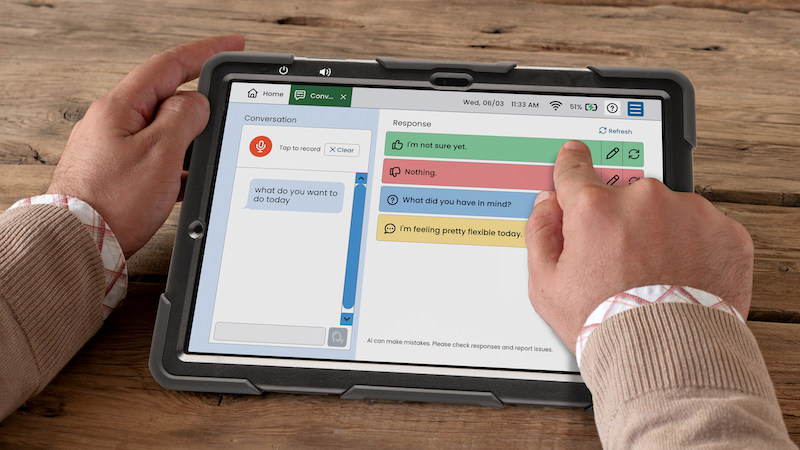
Modeling (also called aided language input) simply means tapping words on the device while speaking naturally. It shows how communication flows without putting pressure on the user.
Try this instead of quizzing (“What’s this word?”):
- Tap “dinner” and “tonight” on the device while you discuss dinner plans.
- Tap “doctor” and “appointment” as you talk about a doctor’s appointment.
- Tap “groceries” when planning out this week’s grocery list.
This modeling shows that AAC is just another way to communicate, not a test to pass.
For device users: Don’t feel pressured to respond immediately when someone models. Just watch and absorb how the device fits into natural conversation.
6. It’s OK to need support
Independence is important, but it’s not the main goal. Communication is often a team effort.
Even people without communication challenges rely on others to clarify or repeat information.
Research shows that communication partner support actually improves AAC outcomes (Kent-Walsh et al., 2015)
Try this: Work with your communication partners to find a support style that feels good to both of you. Maybe they…
- Help you find the right section of your device
- Repeat your message to make sure others understood you.
- Add context when you’re communicating with strangers.
Needing help doesn’t mean failure (we promise!). It means you’re communicating, and that’s what matters.
7. Keep it simple at first
AAC devices can do a lot, but you don’t need to master everything at once.
Trying to learn every feature immediately will put you on the fast track to frustration. Instead, focus on one meaningful goal.
Try this: Pick one section of your device that relates to something you do every day. Maybe it’s:
- Ordering coffee independently
- Sharing feelings at home
- Talking about a favorite hobby
Spend time getting comfortable with that one area before moving on to others.
Confidence builds step by step, not all at once.
8. Use the AAC support available to you
AAC is a journey, not a one-time event. Ongoing AAC support makes a difference.
Try this: Take advantage of training opportunities, like:
- Guided device trials
- Family training
- Ongoing coaching
- Technical support
- Community connection
Lingraphica, for example, offers guided trials and lifetime support to help users feel confident long after they receive their device. Our Adult Weekly Device Tips video series is a great way to build skills over time.
You can also explore real-life AAC success stories for a-ha moments and inspiration.
The right support system helps you move from “I’m not sure” to “I’ve got this.”
Building confidence takes time (and that’s OK)
Some days will feel smooth. Others might feel frustrating. And you know what? We’re here for all of it.
What matters is showing up and using your device, even in small ways. Every interaction builds familiarity and confidence.
And with practical AAC tips, consistent practice, and the right AAC support, meaningful communication becomes more natural over time.
If you or someone you care about is just getting started, take it one conversation at a time. Support is available, progress is possible, and your voice deserves to be heard.
Reference:
Kent-Walsh, Jennifer & Murza, Kimberly & Malani, Melissa & Binger, Cathy. (2015). Effects of Communication Partner Instruction on the Communication of Individuals using AAC: A Meta-Analysis. Augmentative and alternative communication (Baltimore, Md. : 1985). 31. 1-14. 10.3109/07434618.2015.1052153.
About Contributor
 Lauren Hermann, MS, CCC-SLP
Guest Contributor
Lauren Hermann, MS, CCC-SLP
Guest Contributor
Contributors
Lauren Hermann, MS, CCC-SLP
Guest Contributor
Categories
Subscribe to newsletter
Share