




What People with Aphasia and Their Spouses Say Helps and Hinders AAC Use
Published on Nov 10, 2026

A client may use AAC comfortably at home with a spouse and avoid it in the community. What can you do?
As SLPs, we know carryover improves when care partners are involved, and a small focus group study points to another factor in AAC adoption: whether the tool fits the person’s current abilities.
People with aphasia and their spouses explained what helped and why some devices never left the house, offering insights that can guide your AAC selection and partner training.
About this research summary
This article summarizes a qualitative study by Azevedo et al. (2023).
Research findings and clinical best practices may change over time. These summaries are generally maintained as part of our educational archive and are not routinely updated. We encourage readers to review the original research publication and consult current evidence when applying findings in clinical practice.
Speech-language pathologists with clinical or patient questions about AAC are invited to consult with our SLP Clinical Education team.
Key takeaways
- What came up most: Word-finding. Participants described words getting stuck, often with frustration, anger, or sadness.
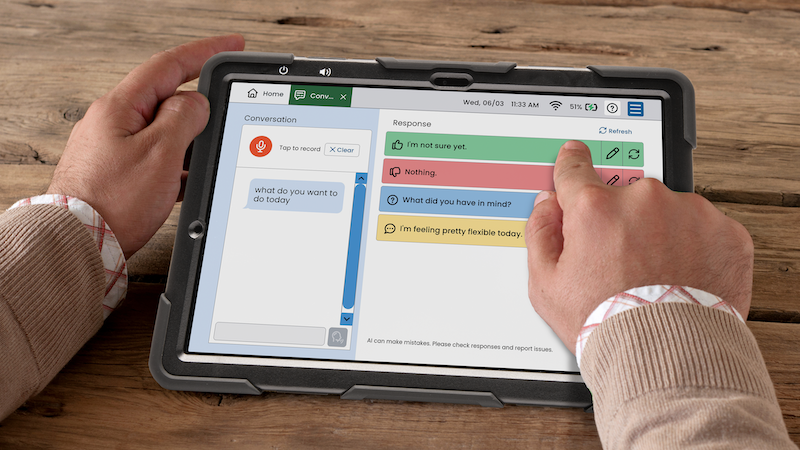
- Personal, practical features helped. Word prediction, voice-to-text, photos, and pre-made word lists stood out. Some couples also used their tools to practice language.
- A poor fit between the tool and the person correlated with less AAC use. Navigation-heavy apps, a bulky device, and feelings of shame led some to stop using AAC or keep it at home.
- Spouses shaped whether AAC took hold. Several helped operate the tools with no formal communication partner training program. One spouse who feared AAC would become a crutch changed their mind after hearing from other users.
- Participants had a clear wish list. They wanted pictograms organized by personal interest, pre-made messages for stressful moments like a police stop, and more public awareness of aphasia.
- Partner training. The authors recommend partner training. Spouses often helped operate AAC tools without formal training, leading the authors to recommend including communication partners in AAC intervention.
Exploring the research
Azevedo and colleagues wanted to understand what people with aphasia and their spouses need from AAC, and why some choose not to use it.
They held two focus groups at a Montreal rehabilitation hospital:
- One in English.
- One in French.
Five adults with aphasia (four after stroke, one with primary progressive aphasia) took part, along with five spouses. AAC experience ranged from none to regular app use. The team then analyzed the discussions for common themes.
Here’s what participants shared:
What helped: One participant couldn’t say or spell “razors” on a call with their daughter, so they texted it using word prediction. Some couples also used their tools to practice language.
What got in the way: One spouse said their partner forgot what they wanted by the time they scrolled past the first screen, so the couple gave up on the app. Others felt ashamed using AAC in public and kept it mostly at home.
What changed a mind: One spouse worried AAC would become a crutch. After hearing other participants describe how their tools helped, this spouse asked the SLPs about options. The authors suggest that hearing from fellow users can soften negative attitudes and support AAC acceptance.
What participants wanted: They asked for pictograms organized around their own interests. One spouse also wanted a pre-made message explaining aphasia in case of a police stop.
Remember, as a qualitative study, this research captures experiences and perceptions. It can’t show which features or strategies lead to better AAC use.
What this means for clinical practice
These findings are most relevant to adults with stroke-related aphasia or PPA, from recent onset to several years post onset, who need AAC to work at home and in the community. The study didn’t report aphasia severity.
Here’s how to put them to work next week. Each tip notes whether it comes from the study or from clinical reasoning:
Match the device to current abilities. In the scrolling example, the person forgot their target before they could find it. Before you choose a layout, consider how much the person has to remember while they search. The authors suggest word prediction can act as a cue.
Based on: participant accounts and the authors’ discussion.
Reassess device use as abilities change. Plan regular check-ins, since language may improve with aphasia recovery or decline with PPA. In the scrolling example, the person’s language abilities later improved, yet the couple never returned to the app.
Based on: participant accounts and the authors’ limitations section.
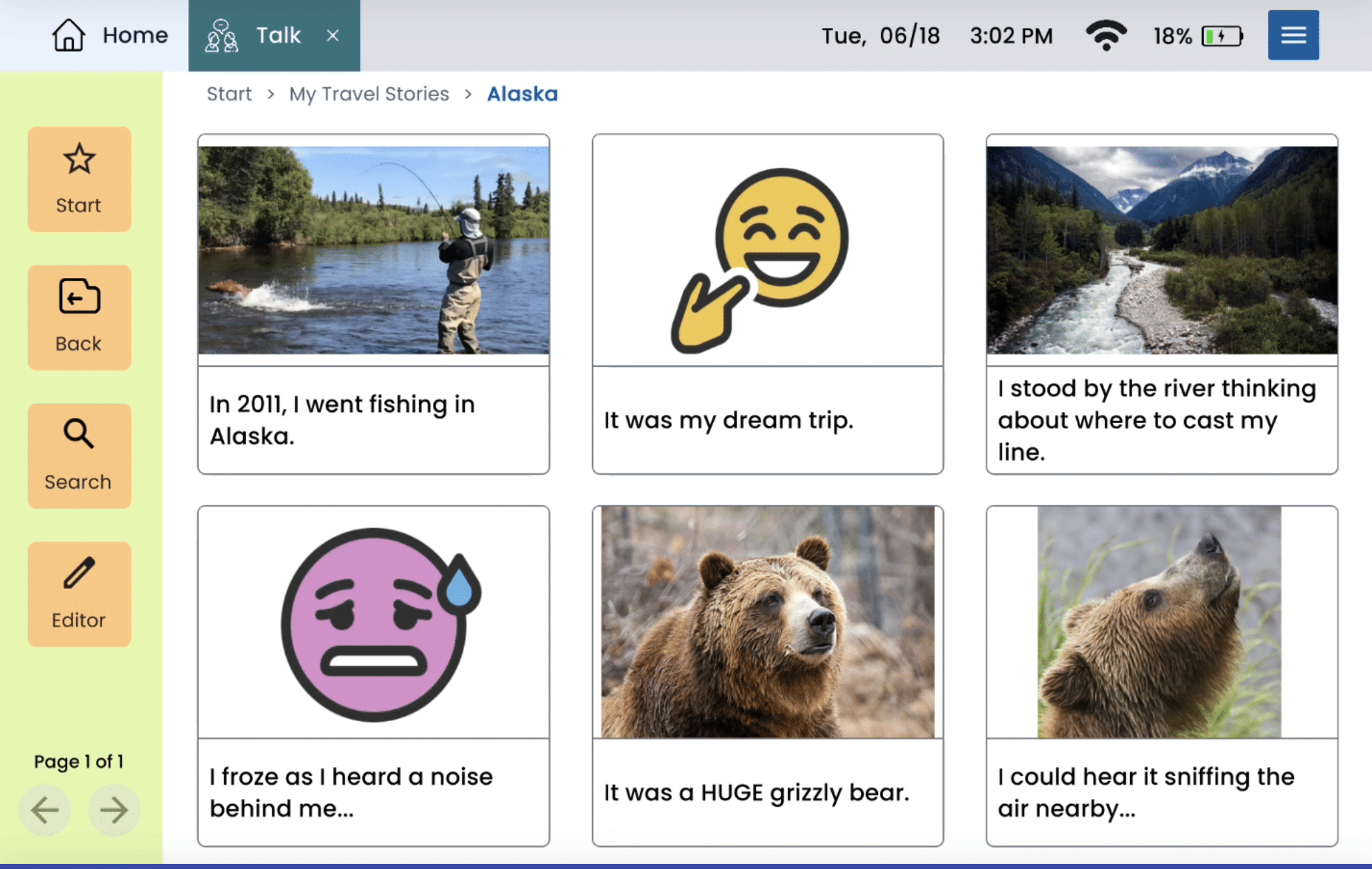
Make it personal. Photos, family names, and pre-made lists were among the supports in this study. The authors recommend organizing vocabulary by topics that matter to the user rather than by semantic category.
Based on: participant accounts and the authors’ recommendation.
Let peers make the case for AAC. Hesitant families may come around after hearing from fellow users, so connect them with peer groups or device demos.
Based on: a participant account and the authors’ conclusion.
Prepare for stressful moments. Speech often breaks down under stress, which is exactly when a short, ready-made message explaining aphasia can help.
Based on: a participant request.
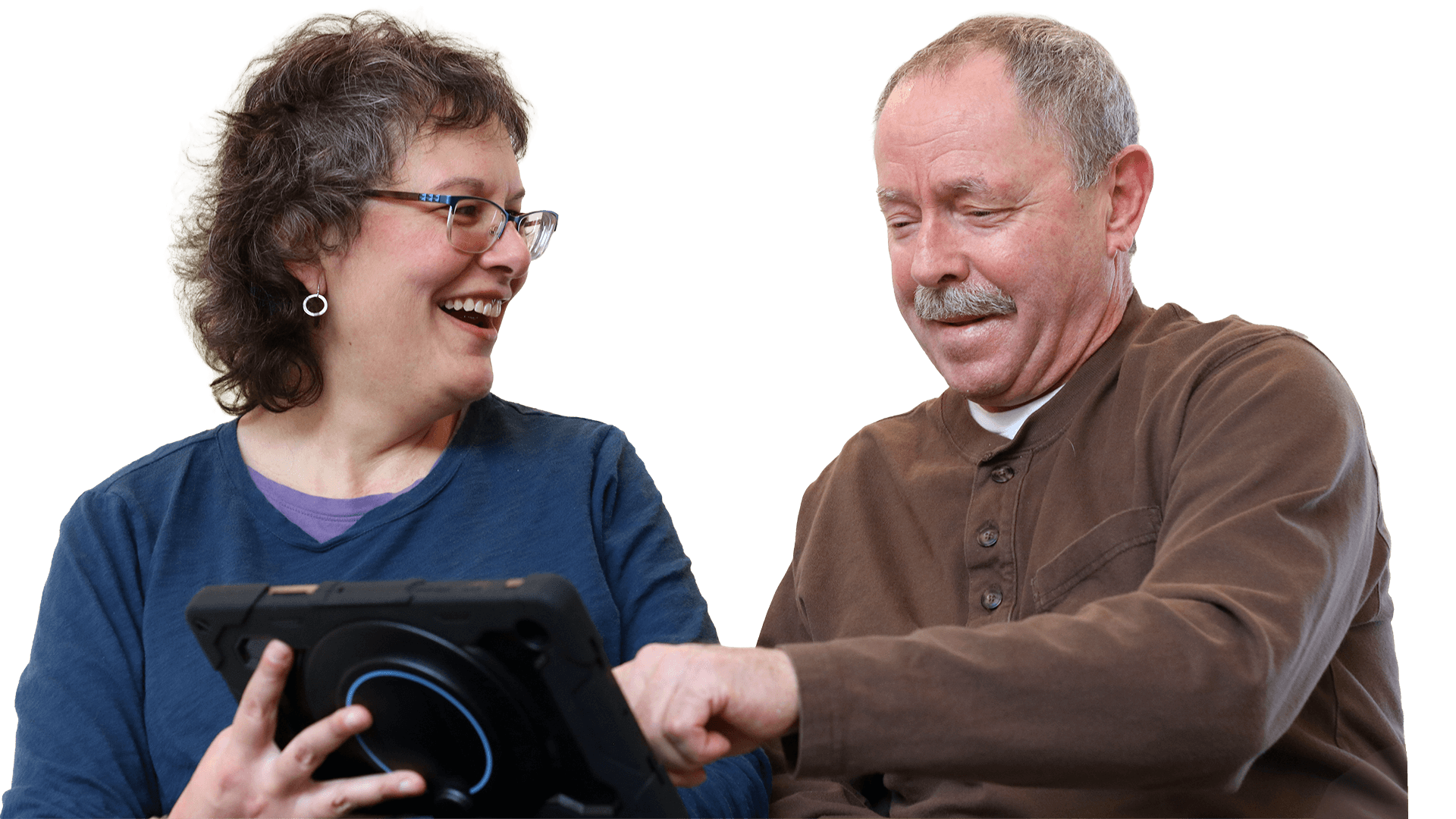
Train partners from day one. Spouses in this study often operated the tools and created their own workarounds. However, none had formal partner training, and well-meant help sometimes added stress. Include spouses in device training from the start, and teach skills like waiting before jumping in and modeling device use.
Based on: the authors’ recommendation; the specific skills are clinical reasoning.
Plan for life outside the house. If a client only uses AAC at home, ask why. Start in settings where AAC is familiar, like an aphasia group, then build toward community outings.
Based on: participant accounts; the step-by-step approach is clinical reasoning.
Applying the research with Lingraphica
In participants’ accounts, poor fit was linked to setting AAC aside, while involved spouses and stories from peers were linked to more comfortable use and openness to AAC.
Lingraphica devices weren’t part of the research, but these resources make it easier to offer both:
Peer connection: Lingraphica’s Join In community offers free support and conversation groups on Zoom. Join In Aphasia welcomes AAC users and non-users with aphasia and even offers a group for couples. Join In AAC invites Lingraphica device users to practice using AAC in a supportive peer-to-peer environment.
Partner and user support: Lingraphica’s AAC trials include 1:1 training for SLPs, device users, and care partners, with lifetime support after purchase. Communication coaching sessions build everyday confidence, and free tech support can help if a glitch ever comes up.
Limitations and clinical considerations
- With 10 participants from one hospital, the findings are preliminary.
- Only devices covered by Quebec reimbursement were represented.
- The study describes experiences and didn’t measure outcomes.
- The authors recommended prioritizing partner training, but it wasn’t tested.
References
Azevedo, N., Le Dorze, G., Jarema, G., Alary Gauvreau, C., Ogourtsova, T., Beaulieu, S., Beaujard, C., Yvon, M., & Kehayia, E. (2023). Understanding the experience of users of communication aids and applications through focus group discussions with people with aphasia and family members. Frontiers in Communication, 8, Article 1219331. https://doi.org/10.3389/fcomm.2023.1219331
About Contributor
 Lauren Hermann, MS, CCC-SLP
Guest Contributor
Contributors
Lauren Hermann, MS, CCC-SLP
Guest Contributor
Categories
Subscribe to newsletter
Share